
After 40 years in this industry, I’ve seen the same pattern in too many boardrooms: planning treated as a static "check-the-box" exercise. In today’s volatile market, that is a liability.
Having worked with thousands of financial institutions, I’ve seen the full spectrum of planning processes. My own journey — from running our support department for years to serving as a hands-on budget and ALM model operator for our clients — has given me a front-row seat to the challenges you face. I’ve helped institutions prepare for everything from intense regulatory exams to high-stakes board presentations. Needless to say, I have seen exactly what works and what doesn't when it comes to effective planning.
True planning must be dynamic, agile, and directly linked to execution. I have distilled this experience into a framework that moves beyond mere spreadsheets, allowing your team to reclaim their potential. By automating the "grunt work" of data gathering, you empower your people to become strategic architects focused on interpretation and data-driven decision-making.
The Conundrum of Conventional Planning
Many institutions unintentionally overcomplicate the process, turning what should be a roadmap into a burdensome chore. Others are simply too hesitant to "beat up" their models—but that is exactly what they are made for! If you aren't stress-testing your assumptions, you aren't truly planning. Many teams fail to leverage what-if scenarios to simulate the impact of new product launches or to visualize how interest rate changes flow through their financials.
Furthermore, I often see institutions wait until year-end to conduct a massive, painful variance analysis. They fear the reforecasting process, so they are left to sift through an entire year of discrepancies. By not reforecasting monthly or quarterly, they miss the opportunity to stay close to the target, making the next planning season an avoidable mountain of work.
None of this means you are doing anything "wrong." You aren't violating regulatory compliance, and your ALCO and Board may be perfectly content with your current rhythm. However, you are likely working much harder than necessary. You are experiencing peaks and valleys of stress rather than a sustainable, evenly spread workflow. Most importantly, you are missing out on the critical, timely insights that lead to better institutional performance.
The Plansmith Planning Cycle
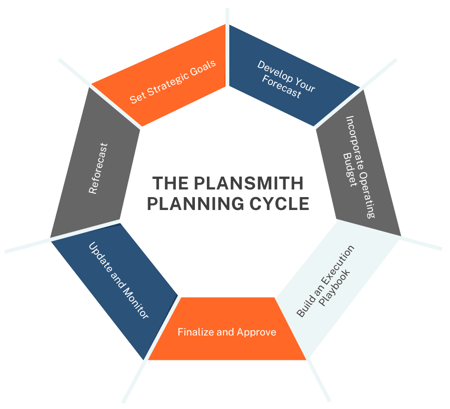
- Set Strategic Goals: Review historical performance and peer data to establish high-level targets (e.g., NIM, ROA, ROE).
- Develop the Forecast: Build financial projections for securities, loans, and deposits aligned with those strategic goals.
- Incorporate Operations: Layer in non-interest income and expense projections based on realistic assumptions.
- Build the Budget Playbook: Translate targets into actionable objectives. Assign clear ownership for execution, monitoring, and reporting.
- Finalize: Present the full budget and playbook to the Board. Once approved, lock the baseline.
- Monitor: Update results monthly. Use automated reforecasting to keep projections continuously refreshed.
- Evaluate: Perform a mid-year reforecast. Review the playbook to identify which items are off-pace and why.
- Adapt: Adjust strategies and action plans to realign with your goals, repeating the process as the market demands.
Moving Forward
Planning is a discipline, not a one-time event. When you shift from static budgeting to a dynamic, playbook-driven approach, you move past spreadsheet limitations and start driving your institution forward with data-backed decisions.
How is your organization currently integrating its strategic goals with day-to-day execution to empower your team?
Let's discuss ways we can help you streamline your planning process.
Sue West
President & CEO